
Context Matters
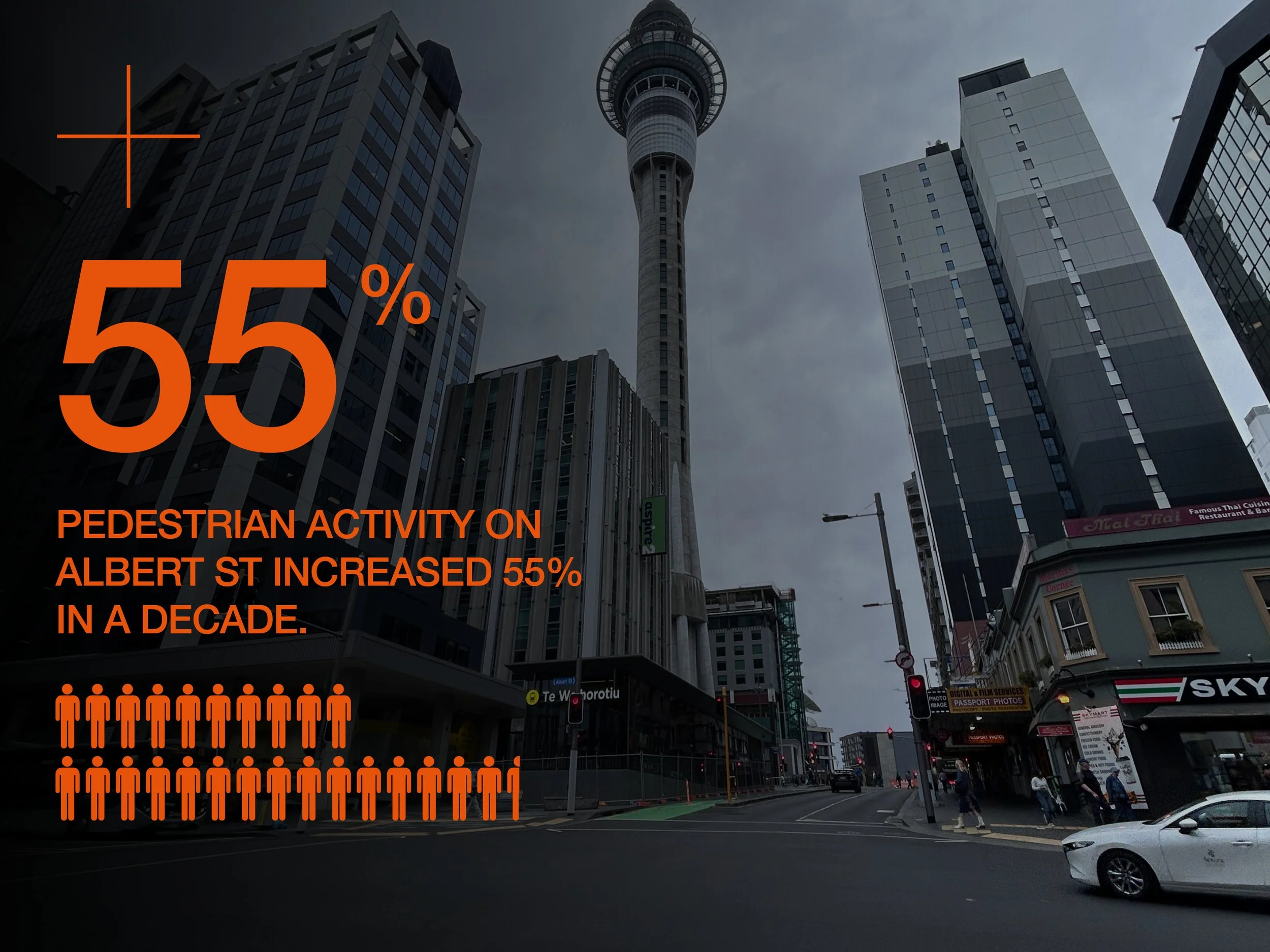
Albert Street recorded 13,122 weekday pedestrian movements in 2026—an increase of approximately 55% over the past decade.
That's significant growth.
But what does it mean?
Is it because more people are living, working and visiting the city centre?
Has Albert Street become a more attractive walking route than it was ten years ago?
Are pedestrians redistributing from neighbouring streets as the public transport network and surrounding street network continue to evolve?
The answer is: probably all of the above. Or perhaps something else entirely.
And that's the important point.
A pedestrian count is a valuable starting point, but it is only one piece of the puzzle. Understanding change requires looking at trends over time, not just individual numbers.
Take Albert Street itself.
When we surveyed the street in 2024, weekday pedestrian volumes were around 40% lower than those recorded just two years later, and around 10% lower than almost a decade earlier. Viewed in isolation, those figures could easily suggest Albert Street was in long-term decline.
But context matters.
In 2024, the City Rail Link works were still having a significant impact on the surrounding pedestrian network. Construction, changing access arrangements and a disrupted public realm all influenced how people moved through the city.
By 2026, with Albert Street largely reinstated, weekday pedestrian activity had increased by almost 70% compared with 2024.
Did Albert Street suddenly become a better street?
Perhaps.
Or perhaps it simply became easier and more enjoyable to use again.
The point isn't to draw a single conclusion. It's to recognise that cities are complex, and people's behaviour responds to a wide range of influences.
That's why we don't stop at the count.
We ask:
Where are people walking?
Where are they stopping?
How long are they staying?
What destinations are attracting them?
Are nearby businesses benefiting from increased activity?
Individual datasets answer individual questions.
It's only by combining evidence over time—and across multiple datasets—that we begin to understand how places are changing and what may be driving that change.
Pedestrian counts tell us what changed. Understanding why requires a broader view of the city and the many factors that influence how people use it.